
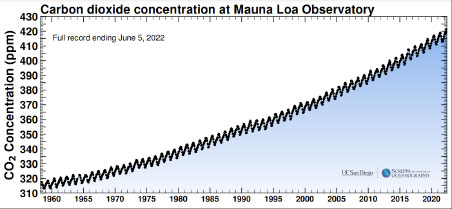
The National Oceanic Atmospheric Administration and the Scripps Institution of Oceanography have announced the Carbon dioxide level in our Earth’s atmosphere has increased to 421 parts per million this year, despite global efforts to reduce it. Carbon occurs naturally, it’s present in the atmosphere, the hydrosphere (water system), the lithosphere (the rocks and Earth’s crust) and the biosphere (all the living things). As the Carbon Cycle perpetually moves Carbon from one system to another it helps regulate Earth’s climate over long term and shorter term timescales.
So why should we care that so much is now in the atmosphere? Unfortunately humans have short circuited this cycle, by raiding the stores of carbon held in these systems known as sinks (oceans, forests, plants, soils, sediments, rocks) and then dumping it at speed into the Earth’s atmosphere in the form of carbon dioxide. It can remain here for thousands of years.
Burning oil, coal and natural gas, trees, solid waste and cement production has freed and recirculated the Carbon in long term storage. The changing of land use to agriculture often involves deforestation releasing carbon held in trees, leaves and plants replacing them with pasture and crops which store much less emit more Carbon dioxide.
Carbon dioxide is also a Green House Gas (GHG) because it prevents heat escaping to space. Without this effect Earth would be an ice planet.
Since warming was first observed in the 1830s, an estimated 1.5 trillion tons of CO2 pollution have been added to the atmosphere since the Industrial Revolution. Current levels have not been this high since 4.5 million years ago.
Rising temperature from CO2 and other GHGs increases the rates of evaporation from water sources (oceans, seas, rivers, lakes) and evapotranspiration from trees and plants.
This mix of Carbon dioxide, additional GHGs, water vapour and energy reveals itself to us as extreme weather events such as storms, flooding, sea level rise, heatwaves, wildfires and droughts. Climate models predict as a general trend that wetter areas are getting wetter while dryer areas are getting dryer.
So the continuing increase of carbon dioxide in our atmosphere really matters because not only is it a powerful GHG, it is acting as a gigantic control switch controlling the amount of water vapour entering the atmosphere.
Its longevity means it has longer to wreak havoc. This resulting increase in temperature is detrimental for all life on Earth.
The highest UK temperature ever recorded was in Cambridge University Botanic Garden on 25 July 2019, when it hit 38.7C.
This year Delhi recorded the highest ever temperature at 49C which resulted in a climate change-induced heatwave.