The CREW Food Group – campaigning for sustainable, local, healthy food.
What does food have to do with climate change?
What we eat, and how that food is produced, affects our health but also the environment.
Food needs to be grown and processed, transported, distributed, prepared, consumed, and
sometimes disposed of. Each of these steps creates greenhouse gases that trap the sun’s
heat and contribute to climate change. About a third of all human-caused greenhouse gas
emissions is linked to food.
The largest chunk of food-related greenhouse gases comes from agriculture and land use.
This includes, for instance:
- methane from cattle’s digestive process,
- nitrous oxide from fertilizers used for crop production,
- carbon dioxide from cutting down forests for the expansion of farmland, other agricultural emissions from manure management, rice cultivation, burning of crop residues, and the use of fuel on farms.
Which foods cause the most greenhouse gas emissions?
Animal based foods: especially red meat, dairy, and farmed shrimp are generally associated
with the highest greenhouse gas emissions. This is because:
- Meat Production often requires extensive grasslands, which is often created by
cutting down trees, releasing carbon dioxide stored in forests. - Cows and sheep emit methane as they digest grass and plants.
- The cattle’s waste on pastures and chemical fertilizers used on crops for cattle feed emit nitrous oxide, another powerful greenhouse gas.
- Shrimp farms often occupy coastal lands formerly covered in mangrove forests which absorb huge amounts of carbon. The large carbon footprint of shrimp or prawns is mainly due to the stored carbon that is released into the atmosphere when mangroves are cut down to create shrimp farms.
Plant-based foods, such as fruits and vegetables, whole grains, beans, peas, nuts, and lentils generally use less energy, land, and water, and have lower greenhouse gas intensities than animal-based foods. Therefore, reducing emissions from the food sector requires changes at all stages, from producers to consumers.
Shifting food systems towards plant-rich diets – with more plant protein (such as beans, chickpeas, lentils, nuts, and grains), a reduced number of animal-based foods (meat and dairy) and less saturated fats (butter, milk, cheese, meat, and palm oil) – can lead to a significant reduction in greenhouse gas emissions compared to current dietary patterns in most industrialized countries.
Agricultural Practices: these need to be improved to reduce greenhouse gas emissions. Fertilisers, pesticides, and herbicides drive biodiversity destruction, on land, water and in the air. Loss of soil biodiversity reduces fertility and soil’s capacity to sequester carbon, while increasing vulnerability to erosion. World soils are being degraded and lost, with approximately 24bn tons of fertile soil lost yearly. The UN Food and Agricultural Organisation suggest that we have only 50 harvests left globally, 40 in the UK.
Extreme weather events across the globe such as heat waves and flooding are also now affecting global food security. Those first affected, both here and abroad, are the poorest.
Reducing food waste is key. Almost 1 billion tons of food – 17 percent of all food available to consumers worldwide – goes into trash bins every year. Producing, transporting, and letting that food rot contribute more than 8 percent of global greenhouse gas emissions.
Core Aims – 3 key components.
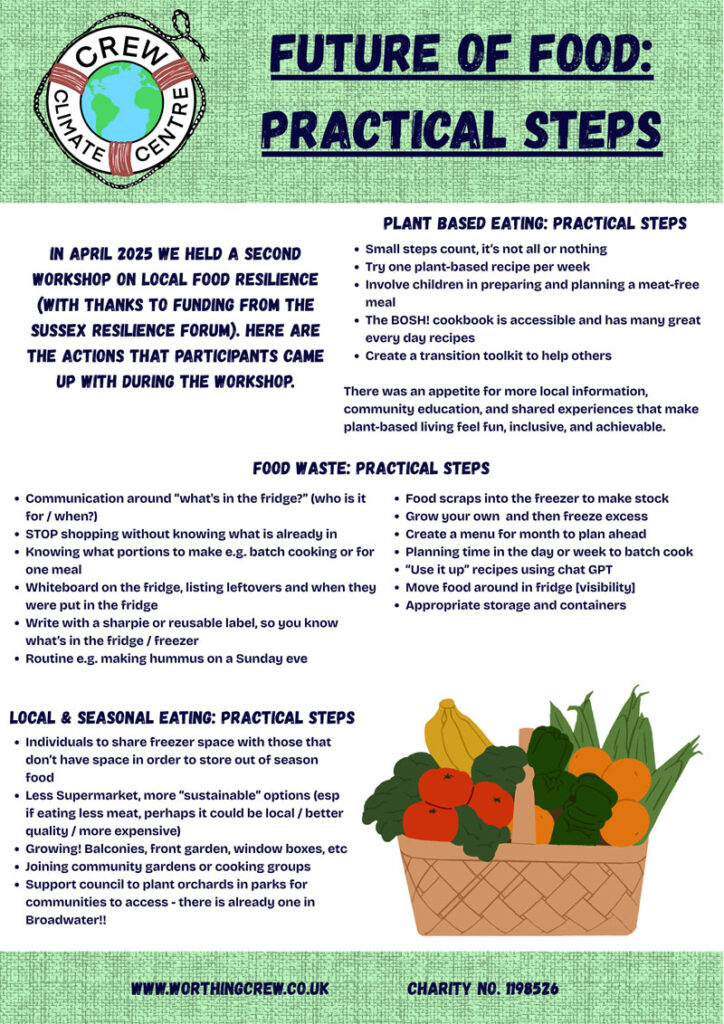
Encourage/advocate plant- based diets in the local community.
a. Collate and promote the evidence of how plant-based diets are hugely beneficial to tackling the climate emergency and to the general health of the population, being mindful of the opposition posed by carnism, and how they are more cost effective too.
b. Advocate/encourage/educate re: plant-based diets.
c. Encourage more plant-based diet in public institutions such as schools, colleges, council offices, prisons, and hospitals.
d. Encourage/motivate/support businesses in the workplace and during events to more plant-based options.
e. Educating people how to cook and encouraging a move to a healthy sustainable DIET (that is, more plant- based.)
Encourage/advocate better agricultural practices and Localism.
f. Support a land use/food and farming strategy that puts the climate emergency at it’s heart, such as those created by the Land Workers Alliance, SUSTAIN and the Food, Farming and Countryside Commission
g. Encourage/support re-wilding and ecological restoration.
h. Support increasing local food production in a resilient way – needs to be regenerative and resistant to climate shocks.
i. Advocate for our local schools, universities, retirement homes and other organisations to buy much more local food, thereby supporting local producers to expand their output.
j. Support local farmers and the creation of farmers markets and local veggie box schemes. Encourage the buying of local, seasonal, and organic produce where possible.
Encourage/advocate reducing food waste.
k. Encourage avoiding waste or throwing away food by only buying what is needed and using it carefully.
l. Educate how to properly store, freeze, and refrigerate food to avoid waste.
m. Encourage putting food waste to use – instead of throwing away food scraps, compost them.
n. Encourage/educate the use of leftovers.
o. Educate about food labelling.
p. Educate about using less water.
q. Encourage the donating of food that would otherwise be wasted. For example, Apps can connect neighbours with each other and with local businesses so surplus food can be shared, not thrown away.